
A patent doesn't make your product safe to sell. This FTO checklist shows which products need a freedom-to-operate review before launch, and what to do next.
"I filed a patent — so I can sell it safely now, right?" It is one of the most common questions cross-border sellers ask us, and one of the most expensive misconceptions in the business. The product is selling well, a takedown notice or a cease-and-desist letter arrives, and the patent certificate on the wall does not help. Because "I own a patent" and "I am free to sell" answer two completely different questions.
This guide covers three things: which products need extra caution before launch, how to make a first-pass read on infringement risk, and when a freedom-to-operate (FTO) review is worth the money.
1. Why "I have a patent" does not mean "I can sell safely"
A patent protects your innovation. What it gives you is the right to exclude others from practising it. Whether your product can go to market depends on something else entirely: whether it falls within the scope of somebody else's live patent.
A common example. You design a storage box with a magnetic closure and obtain a US design patent — good, that protects the appearance you claimed. But if the magnetic closure mechanism reads on the claims of a live utility patent owned by someone else, selling that box in the US may still constitute infringement. The reverse also holds: the internals are clean, but the overall appearance is too close to a live design patent, and you have risk again.
So the accurate statement is this: owning a patent gives you exclusivity over your own innovation. It does not give you permission to sell the product.
Rule of thumb: a patent portfolio answers "how do I protect myself"; an FTO review answers "am I stepping on someone else".
2. What FTO actually means
FTO stands for freedom to operate. It answers a single question: can your product be made, sold or imported in the target market without falling within the scope of a third party's enforceable patent rights?
Note the framing. It is not "is there an identical product on the market". It is "could your structure, technical solution or appearance fall inside claims that are granted and still in force — and are there pending applications that could become an obstacle later?"
A proper FTO review usually delivers four things:
· Targeted searching in the target market — for the US, granted patents and pending applications together;
· A claim-by-claim or figure-by-figure comparison to define the scope you are being measured against;
· A risk rating for each relevant right;
· For high-risk items, concrete options: design around, take a licence, or change direction.
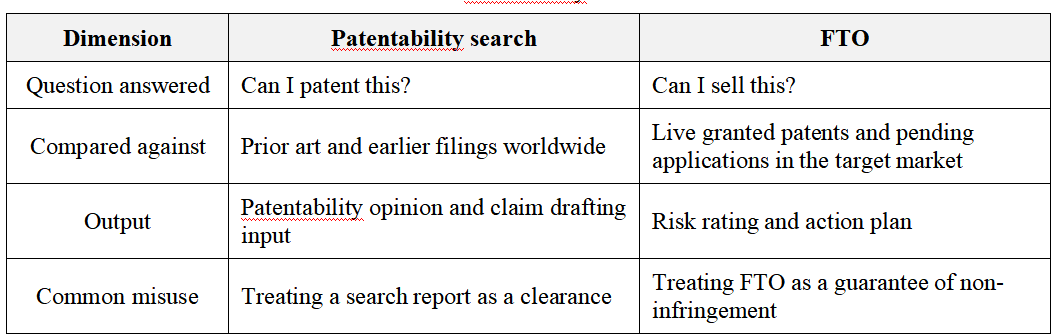
Sellers often confuse FTO with a patentability search. The two serve different purposes.
Table A Patentability search vs FTO
3. A priority checklist: which products deserve an FTO review first
Not every product needs a full FTO review. Use the table to locate yourself, then decide how much to invest.
Table B Pre-launch FTO priority checklist
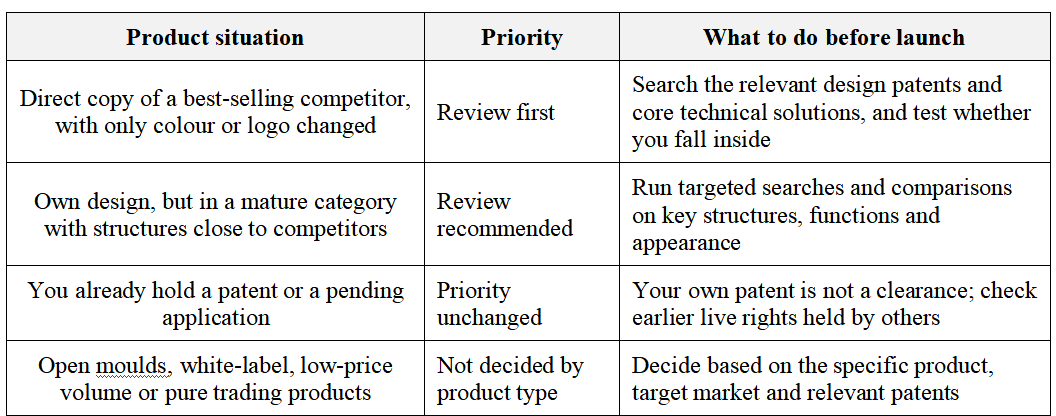
A note on how to read this table: it ranks priority, it does not deliver an infringement conclusion. Product category alone never determines risk. What matters is how your product's specific features relate to the scope of someone else's live patent.
Two points deserve their own paragraph.
First, "fully original and patented" is not low risk. A US patent grants a right to exclude others within the limits of the law. It does not authorise you to make, use or sell your own product. A patented product can still fall within the scope of an earlier patent.
Second, direct copies of best-sellers deserve attention first. Hot products usually sit on years of accumulated filings — appearance, structure, core function. Changing a colourway and a logo rarely changes the scope you are measured against.
One cost principle: the more you have committed to tooling, inventory and launch spend, the more a pre-launch risk read is worth. The value is not the report. It is avoiding takedowns, forced redesigns, stranded stock and dispute costs later.
4. If you do find a risk, work through three steps
Step one: separate "actually covered" from "looks similar". A design patent is judged on the overall visual impression defined by the patent figures, not on one matching detail. A utility patent requires the technical solution to fall within every element of a claim. Similar-looking is not the same as infringing. This is where sellers either panic or become complacent.
Step two: check the legal status. US patents expire, and lapse for non-payment of maintenance fees. If the relevant right has expired or terminated, the risk based on that patent usually drops materially. Keep going though — check the patent family, other rights that are still live, and pending applications that could block a future launch. If you believe a patent is invalid, that argument needs prior art and legal analysis, not intuition.
Step three: decide whether to design around, take a licence, or change direction. All three are legitimate. Which one is right depends on how feasible a design-around is, the commercial terms available, and what the product is worth to you.
One caveat. FTO is a claim-level, figure-level comparison. Utility patents turn on the limitations in the claims; design patents turn on the overall design shown in the figures. Judging from product photos or a few surface differences is where mistakes happen.
5. Three common myths
Myth one: "Other people are selling it, so it must be safe." Others may simply not have been caught, reported or enforced against yet. And "I searched and found no identical patent" is not a clearance either — a weak search strategy misses rights, and unpublished applications cannot be found at all.
Myth two: "My patent protects me from complaints." Your patent and theirs are separate rights. Neither authorises the other. In a complaint, what matters is their rights and whether your product overlaps.
Myth three: "FTO guarantees no infringement." FTO reduces uncertainty; it does not eliminate it. No search can cover every pending or unpublished application. An assessment gives you a risk level, not certainty. Anyone promising a guarantee of non-infringement deserves a follow-up question.
6. FAQ
Can an FTO report serve as legal assurance of non-infringement?
No. An FTO review is a risk assessment based on publicly available information, and its output is a risk rating plus recommended actions. It reduces uncertainty in your decision. It is not a legal opinion, and it cannot rule out patents that publish later.
How is design patent infringement judged?
On the overall visual design defined by the patent figures, tested by whether an ordinary observer would find the overall impression confusingly similar. It is not a detail-by-detail comparison. Local differences do not save you if the overall impression is close.
Is searching patent databases myself enough?
It works as a first screen. The hard part is how you build the search, how you consolidate families, how you read claims, and how you define the scope of design figures. Get those wrong and the conclusion drifts. The checklist above tells you whether to bring in a specialist; it does not replace the comparison.
When is the best time to run an FTO?
Before tooling. That is when changing the design is cheapest. Once the mould is cut, the packaging is printed and the stock is booked, your room to design around shrinks fast.
How is FTO different from patent monitoring?
FTO happens before launch and looks at your own product. Monitoring is ongoing: it watches new patents and complaints in the market that could affect you. One is a checkpoint; the other is a long-running process.
7. Bottom line
Back to the opening question: if I have a patent, can I sell safely?
Your patent protects what is yours. FTO tells you what lies ahead. You need both before "safe" means anything.
For a cross-border seller, the worst outcome is not a product that fails to sell. It is a product that sells — after you have paid for tooling, inventory and ads — and then gets taken down or frozen, with both cash and stock locked up. Before the design is frozen and the mould is cut, a modest spend on clearing risk is usually the best-value money in the project.
About Foxsight
Fuyan is a cross-border IP practice with seven years of frontline experience. We focus on the US market: FTO searches and infringement analysis, patentability searches, filing strategy for design and utility patents, and responses to infringement complaints, including design-arounds.
What we assess is not only whether a product can be patented, but what patent risk sits in front of launch and how to reduce it.
For a first-pass view on a specific product, prepare the product details, design drawings and target market, and reach us through our website.